$47 Million Katy Loan Shows How Supply Can Outlast Houston’s Slowdown
A long-term HUD financing package puts 279 Sunterra apartments on the future competitive map, despite a shrinking metro pipeline.

Key takeaways
- $47 million: Dwight Capital financed Hunington Properties’ 279-unit The Vic at Sunterra in Katy.
- 24 months: Reported interest-only period precedes a fully amortizing 40-year term; completion targets fall 2028.
- 3,772 units: Houston Q2 deliveries in Cushman & Wakefield’s series, following 4,460 in Q1.
- 65.7%: Class A share of Houston Q2 net absorption in Colliers’ research; Class B accounted for 14.1%.
Dwight Capital has closed a $47 million HUD-backed construction loan for Hunington Properties’ 279-unit The Vic at Sunterra in Katy, according to Commercial Observer’s October 1 report. The project targets completion in fall 2028. For Houston apartment investors, the news shows how long-term financing can help new supply proceed even as the broader construction pipeline contracts.
The investment implication is straightforward: fewer apartments under construction across the metro do not guarantee fewer competitors around a particular property. A financed project has moved beyond an announcement, although closing a loan does not establish that construction is complete or delivery certain. Nearby owners should put it on their competitive map now.
24 months of interest-only payments, then a long runway
Commercial Observer reports a 24-month interest-only period followed by a fully amortizing 40-year term, with nonrecourse HUD-backed financing. That structure links construction financing to a much longer repayment horizon. It can reduce dependence on arranging a separate permanent loan immediately after completion, when leasing performance may still be uneven.
Interest-only does not mean interest-free. It postpones principal repayment, while the later amortizing period requires both interest and principal payments. A developer must plan for that change in debt service alongside construction spending, operating expenses and the cash needed to fill apartments; a generous calendar cannot pay the bills by itself.
The size of the loan also requires careful interpretation. HUD’s underwriting framework limits maximum mortgage amounts through multiple constraints, including debt coverage and applicable loan ratios. Without the project’s total cost, equity contribution, interest rate and underwritten income, the reported financing amount cannot establish its leverage, profitability or replacement cost.
3,772 deliveries show the slowdown already underway
Cushman & Wakefield’s Houston Q2 report recorded 3,772 apartment deliveries, following 4,460 in Q1. It counted 11,756 units under construction at quarter-end, down 36.4% from a year earlier. Those are midyear observations, rather than an October inventory, but they explain why a newly financed development deserves attention.
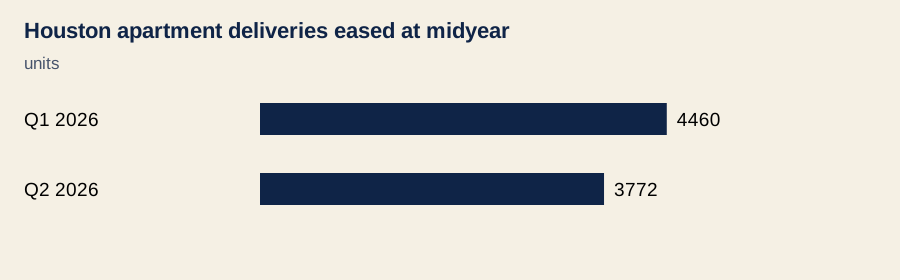
Source: Cushman & Wakefield, Houston Multifamily MarketBeat Q2 2026. Quarterly deliveries; one provider series.
Slower deliveries can give existing communities time to fill vacant units and reduce the spending needed to win each lease. Yet construction financing works with a lag: today’s closing can become tomorrow’s competing inventory. The Sunterra project therefore matters more to an owner’s future rent assumptions and exit plan than to this week’s leasing traffic.
Northmarq’s midyear Houston outlook projected roughly 5,600 deliveries in 2027 and described lighter supply potentially extending into 2028. That is a preliminary forecast, not a committed delivery schedule. A fall 2028 target sits beyond its 2027 estimate, so this loan should not simply be added to that forecast.
The research providers also count different markets and property sets. Colliers reported 13,274 units under construction in Q2, compared with Cushman & Wakefield’s 11,756; their public summaries do not fully reconcile the difference. Treat each series consistently, and avoid averaging them into a supposedly precise Houston total.

65.7% of absorption went to Class A
Colliers’ Q2 Houston research attributed 65.7% of net absorption to Class A apartments and 14.1% to Class B, with positive absorption across all property segments. That distribution describes where occupied units increased during the quarter. It does not measure Sunterra demand or tell us what rents this project will achieve.
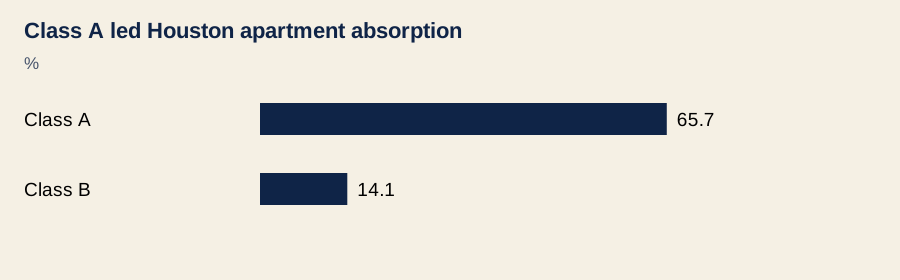
Source: Colliers, Houston Multifamily Q2 2026. Shares of quarterly net absorption; selected classes, not total inventory shares.
For existing owners, the distinction matters because newly built apartments can compete through amenities and introductory pricing before they compete through established reputation. An older community may retain residents by offering a lower total monthly housing cost or better service. An expensive renovation will not necessarily make its rent ceiling match a new development.
The relevant question is whether the renters considering a nearby property would also consider this one. Compare unit layouts, household budgets, commute patterns and the timing of availability. Metro absorption helps establish the backdrop; a property’s actual prospects, renewals and competing quotes are more useful for deciding how much pricing power it has.
What it means for owners and investors
Start with net operating income, or NOI: rental revenue after concessions and operating expenses, before debt service. A competitor that delays rent increases or raises turnover can weaken NOI even if occupancy remains respectable. Property taxes, insurance, maintenance and payroll still need funding, so a fuller building is only part of the operating test.
For acquisitions, basis means the total amount invested, including purchase price, closing costs and planned improvements. The Sunterra loan is debt, not a sale price or a development budget. Using it as a price-per-door comparable would confuse the financing stack with the value of the underlying real estate.
For valuation, a cap rate translates expected property income into a price. Better anticipated income can support value, but fresh construction competition may make buyers demand a larger cushion for leasing risk. Long-lived debt on a competing project does not mechanically compress the cap rate on an existing apartment community.
Refinancing deserves its own downside case. Freddie Mac’s new refinance test became effective October 1, a reminder to ask lenders which current assumptions they apply to a prospective loan. Owners should model slower leasing, continuing concessions and the scheduled debt payment before assuming that a future refinance will return capital.
What to watch next
Track observable milestones: construction progress, announced leasing dates, published asking rents and actual move-ins. Fall 2028 remains a reported target. The closer the project comes to delivery, the more useful its lease terms become for updating nearby renewal offers and underwriting an exit.
Also watch whether the broader supply slowdown reaches the specific properties in your competitive set. If fewer openings let owners improve collections and retention, NOI can recover without heroic rent growth. If new communities keep competing aggressively for the same households, a metro recovery can coexist with a difficult local leasing market.