7.5 Million Square Feet: Houston’s Industrial Recovery Tests Apartment Demand
Industrial move-ins strengthen Houston’s employment-corridor story, but apartment owners still need evidence of hiring and collected rent.

Key takeaways
- 7.5 million sq. ft.: Savills’ Q3 industrial net absorption.
- 7.2%: Savills’ Q3 industrial vacancy.
- 2.38 million sq. ft.: CBRE’s Q3 Southeast net absorption.
- 0.2% decline: August manufacturing payrolls versus a year earlier, per BLS.
Houston’s industrial recovery is putting more business space to work. In its October 8 report, Savills records 7.5 million square feet of third-quarter net absorption and 7.2% vacancy. For apartment investors, the useful question is whether those occupied facilities will bring more households into nearby rentals, improve resident incomes or simply rearrange existing employment.
Our reading: this is a promising signal for apartments serving industrial employment corridors, with an important condition attached. Space demand needs to turn into sustained payrolls and collected rent before it deserves a higher valuation. A warehouse can be busy while a nearby apartment building still competes hard for residents.
Occupied space makes the signal stronger
Net absorption measures the change in occupied space, rather than the volume of contracts signed. CBRE’s separate Q3 survey reports 7.17 million square feet absorbed and 6.3% vacancy. Its snapshot puts Southeast absorption at 2.38 million square feet, ahead of the other submarkets shown below.
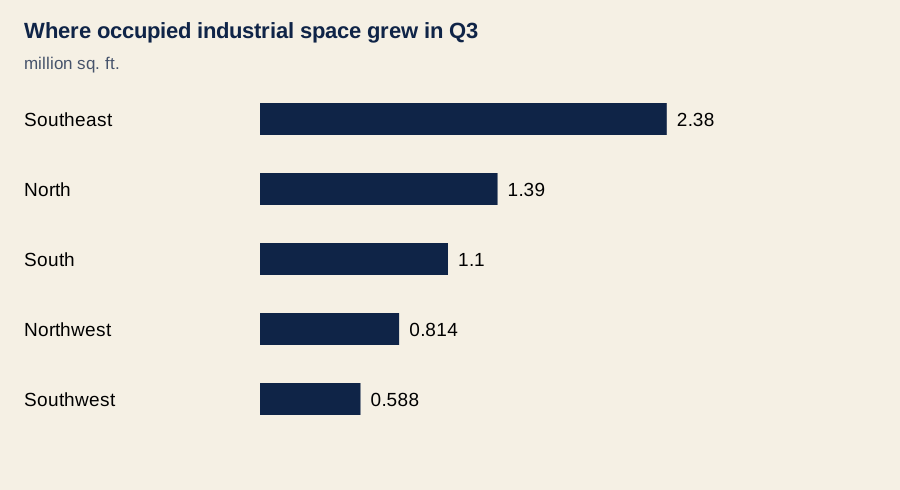
Source: CBRE Q3 2026 snapshot. Selected submarkets; net absorption, not leases or jobs. Zero baseline.
Actual occupancy matters because employers can sign leases before hiring, installing equipment or opening operations. Even a completed move-in might consolidate existing sites rather than add workers. Apartment owners should treat the report as a map for further investigation, then ask which facilities are expanding their local workforce and where those employees already live.
Savills tracks 717.0 million square feet of inventory, versus CBRE’s 628.50 million. CBRE includes industrial buildings of at least 20,000 square feet; Savills notes that statistics incorporate direct and sublease information. Those disclosures do not fully reconcile their universes, so the figures stay separate rather than becoming a blended vacancy estimate.
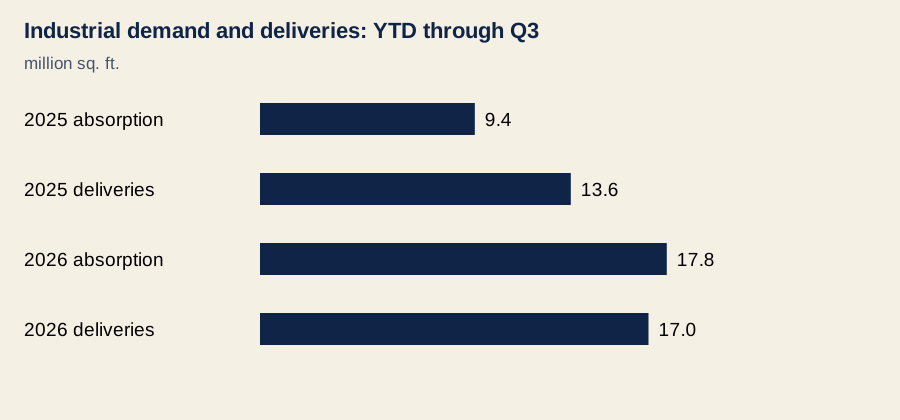
Source: Savills Q3 2026 key statistics. Separate series; absorption and deliveries, not employment. Zero baseline.
The supporting chart compares year-to-date absorption and deliveries within Savills’ own series. It shows demand keeping pace with substantial additions to space, rather than an industrial market recovering solely because builders stopped delivering. That distinction matters for the durability of the employment base, although industrial completions and apartment completions are entirely different supply measures.
The missing step is household demand
The labor evidence remains mixed. The BLS Houston summary updated October 5 shows August manufacturing employment down 0.2% from a year earlier, while trade, transportation and utilities was unchanged. These nonseasonally adjusted payroll figures predate the latest quarter-end industrial reading and do not establish hiring at any particular facility.
An expansion can increase shifts, output or storage capacity before it produces a meaningful increase in headcount. Automation and workers commuting from existing homes can also weaken the connection between occupied square footage and new rental households. This is why converting warehouse area into an apartment-demand estimate would create precision the evidence cannot support.

Geography is the next filter. H-GAC’s regional planning framework incorporates accessibility and household location choice, a reminder that jobs and homes interact through the travel network. For an apartment owner, the practical comparison is commuting time, shift schedules, housing cost and available alternatives, rather than a straight-line radius around a new industrial building.
The potential benefit can reach existing residents as well as newcomers. More dependable work or additional hours can support collections and reduce turnover, even without a large migration wave. Conversely, an employer recruiting from another local company may redistribute demand across neighborhoods instead of increasing it for the metropolitan area.
What it means for owners and investors
Apartment competition is still the immediate constraint. Cushman & Wakefield’s Q2 apartment report records 6,177 units absorbed, yet effective rents were down 2.3% year over year. This older operating context shows why healthy demand need not create pricing power immediately; it does not tell us what October rents or collections are at a specific property.
Owners near industrial corridors should first look for more qualified applications, fewer vacant days and stronger renewals. An improvement that reduces concessions or turnover costs can lift net operating income before advertised rents rise. Maintenance, insurance and tax expenses still determine how much of the additional revenue reaches the bottom line.
That sequencing also matters for debt service. A lender can recognize documented recurring income more readily than a forecast built around a nearby facility. If current collections do not support the required payments, expected industrial hiring does not fund the gap; the owner still needs a workable reserve, equity contribution or financing structure.
For acquisitions, separate the building’s existing income from the price paid for anticipated neighborhood growth. A lower basis can provide room for repairs and an uneven leasing recovery, but paying today for employment that has not materialized reduces that cushion. Employer concentration should also influence the margin of safety when the same company supports many residents.
Cap rates should follow the quality and durability of cash flow alongside financing conditions and buyer competition. A stronger employment corridor may eventually support a more dependable exit, but there is no verified numerical cap-rate adjustment in these reports. Underwrite the sale using a defensible income stream and test a slower recovery instead of assuming both faster rent growth and a lower exit cap rate.
What to watch next
Watch subsequent industrial occupancy alongside employer hiring and apartment applications in the same corridors. Port Houston’s monthly trade report provides another activity check, but cargo volumes and vessel movements are not payroll counts. A sustained rise in several independent measures would make the apartment-demand case more convincing than any single large lease.
At the property level, track which employers appear in new applications, whether move-outs are falling and whether collected revenue improves after concessions. Compare that evidence with competing apartment deliveries before changing renewal assumptions. Houston’s industrial recovery gives owners a useful place to look; the rent roll will tell them whether the opportunity has arrived.