$775 Million VoltaGrid Close Gives Houston a New Demand Signal
Fresh equity strengthens a Houston power-services business, while local hiring and project execution determine the apartment payoff.

Key takeaways
- $775 million primary equity investment closed from Blackstone funds and Halliburton.
- $800 million secondary investment provides no additional proceeds to VoltaGrid.
- 176 TWh of U.S. data-center electricity use in 2023, versus 58 TWh in 2014.
- 1.5 GW INNIO equipment agreement has delivery scheduled by 2028.
Houston-based VoltaGrid closed a $775 million primary equity investment from Blackstone Tactical Opportunities funds and Halliburton, according to its October 5 announcement. For apartment investors, the significance is a better-funded local business serving power-intensive customers. The release establishes a financing close; it does not establish new Houston jobs, an office expansion or additional apartment leases.
That distinction matters because capital can reach a city before the resulting households do. The apartment opportunity depends on where the company hires, where suppliers expand and whether employees need housing near those workplaces. A promising business announcement deserves attention, but the rent roll still needs its own evidence.
$775 million funds the business
The closing also included an $800 million secondary investment, enlarged from the $225 million announced in May. Those purchases gave certain existing owners liquidity and produced no additional proceeds for VoltaGrid. The larger secondary transaction therefore should not be treated as another operating budget for equipment, payroll or local expansion.
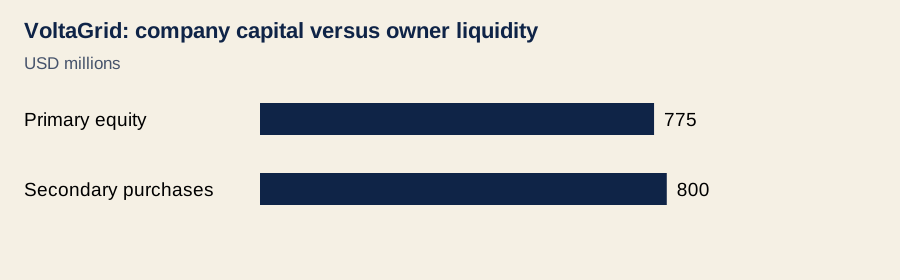
Source: VoltaGrid October 5, 2026 release via GlobeNewswire/Ritzau. Primary capital goes to the company; secondary purchases do not. Neither bar is a Houston spending allocation.
Primary equity and secondary purchases can both strengthen a company’s investor base, but their cash-flow consequences differ. New company capital can support execution; a transfer of existing stakes changes ownership. For an apartment owner trying to estimate future demand, tracing where money goes is more useful than simply adding the transaction values together.
Blackstone’s May announcement connected the primary raise with deployment of power systems for data centers, microgrids and industrial applications. It also described plans to expand Propell facilities in Granbury, Texas. That named manufacturing location is a useful reminder that a Houston headquarters does not make every associated capital expenditure a Houston investment.
The October closing release does not provide a Houston spending allocation or hiring timetable. It also does not independently confirm completion of every manufacturing plan described in May. Those missing details limit how directly an investor can translate the financing into near-term demand for a particular apartment community.
176 TWh explains the power opportunity
The underlying customer need is real, even if its local housing effect remains uncertain. The Department of Energy’s summary of its 2024 data-center study reported U.S. data-center electricity use of 58 terawatt-hours in 2014 and 176 terawatt-hours in 2023. These are historical national totals, not current Houston consumption or VoltaGrid revenue.
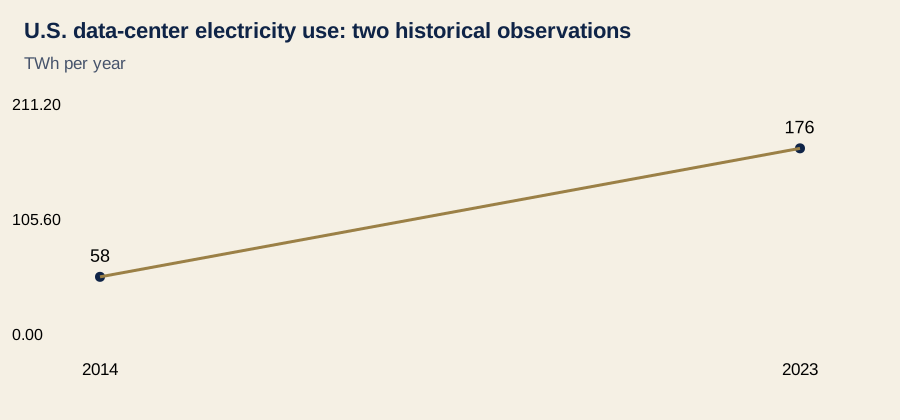
Source: DOE December 20, 2024 summary of LBNL report. U.S. historical totals for 2014 and 2023; line connects observations, not intervening annual estimates. No forecast shown.
CBRE’s 2026 data-center outlook identifies power cost and delivery speed as central site-selection considerations and describes growing interest in generation behind the meter. In plain English, customers are looking for ways to obtain usable power at their facilities. That creates a business opening for equipment, engineering and ongoing service providers.
Execution still takes time. INNIO’s February agreement with VoltaGrid covered 1.5 gigawatts of generation infrastructure, including 300 gas engines, with delivery scheduled by 2028. An equipment order and a scheduled delivery are different milestones from an operating facility, collected revenue or a permanent local workforce.
Apartment demand could arrive through engineers, project managers, field technicians and supporting businesses if those roles expand locally. Some work may instead occur at distant customer sites or manufacturing locations. Contractors may also need temporary accommodation rather than a conventional annual apartment lease, changing both the timing and durability of demand.

What it means for owners and investors
Owners should treat the financing as a reason to investigate employment links around their properties. Ask whether new prospects work for power-services businesses, whether they are relocating and how long their assignments last. Leasing records can distinguish additional households from residents moving between Houston properties without increasing metro demand.
If incremental residents reduce vacancy, net operating income can improve through more collected rent and less downtime. But occupied units obtained with expensive concessions or unusually high turnover may contribute less than the headline leasing count suggests. The relevant measure is income retained after the costs required to win and keep those residents.
There is also a timing mismatch to manage. Equipment deployment and customer commissioning can move more slowly than an acquisition loan’s payment schedule. Debt service must be covered by existing property cash flow and available liquidity while any hoped-for demand develops; corporate financing does not reduce an apartment owner’s borrowing obligations.
For acquisition basis, give documented operating performance more weight than proximity to an exciting industry. A purchase price that requires unannounced hiring or immediate concession burn-off leaves little room for delay. Use potential employment spillovers as a sensitivity case, with the base case supported by current leasing and competitive supply.
Cap rates need a separate assessment. Northmarq’s September midyear report found improving national apartment fundamentals alongside capital-market pressure from rising interest rates. That national assessment is context, not a Houston cap-rate quote, and it shows why a stronger demand story can coexist with more difficult financing.
At exit, higher sustainable NOI can support value if the capitalization rate is unchanged. If buyers require a higher yield, some operating gains can be offset by a lower valuation multiple. Avoid giving the same announcement credit twice by assuming it both raises apartment income and automatically compresses the exit cap rate.
What to watch next
The most useful follow-up is a specific Houston hiring or facilities announcement, followed by evidence that the jobs are being filled. Watch where equipment is built, where service teams are based and when customer systems enter operation. Each milestone narrows the distance between an institutional investment and a household looking for a home.
At the property level, compare employer-related inquiries, signed leases, renewal behavior and concessions with competing communities. The financing supports a credible business-growth channel, but its apartment impact must be earned through local execution. Houston owners can follow that channel closely while keeping today’s purchase and debt decisions anchored in cash flow they can verify.